
 English
 简体中文
简体中文
Why Safety Innovation Matters in Transfer Cart Design
Industrial transfer carts operate in environments where personnel, expensive equipment, and valuable products coexist in close proximity. Safety innovations in cart design directly protect workers and reduce the liability exposure of facility operators. Beyond the ethical imperative of protecting workers, effective safety systems reduce the hidden costs of workplace accidents—production delays, equipment damage, workers' compensation claims, regulatory penalties, and reputational harm. Understanding current safety technologies helps procurement managers specify equipment that addresses real operational risks.
1. Advanced Emergency Stop Systems
Emergency stop functionality has evolved beyond simple contactor-based power interruption. Modern electric transfer carts incorporate redundant emergency stop circuits that cut power to drive motors and engage spring-applied brakes within milliseconds of activation. The best implementations use dual-channel safety relays that verify correct circuit state and will fail-safe if any component malfunctions—preventing the dangerous scenario where a failed relay allows unexpected cart movement after an emergency stop.
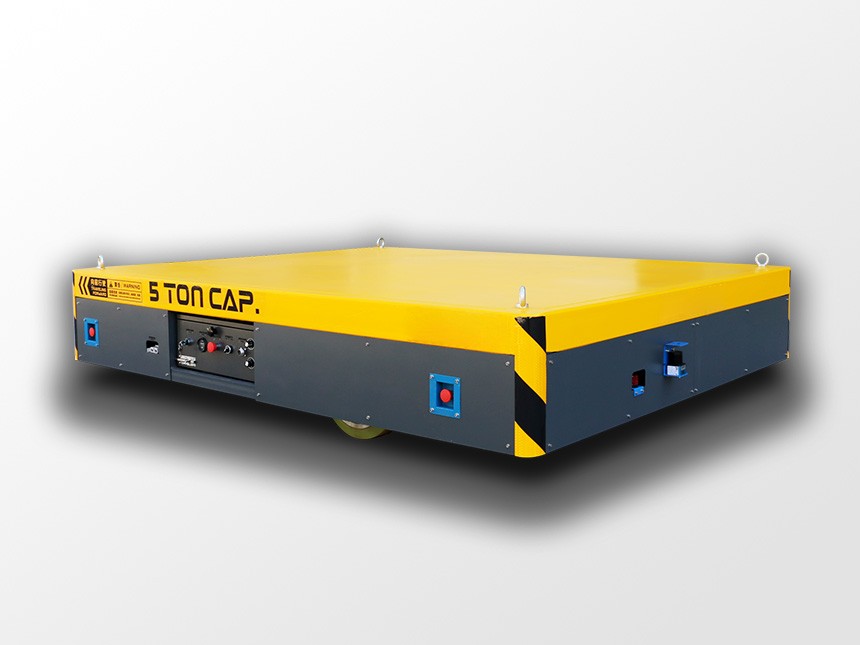
Emergency stop buttons should be positioned at multiple locations on the cart and included on the remote control. Activation should trigger both immediate motor power cutoff and audible/visual alerts that warn nearby personnel the cart is stopping. Some systems integrate with facility-wide emergency stop networks, allowing cart stops to trigger alerts across the production area when coordinated shutdowns are required for safety reasons.
2. Obstacle Detection and Avoidance
Static obstacle detection using limit switches or bumpers has been standard for decades—useful for detecting a collision already in progress but providing minimal prevention. Contemporary safety systems use active sensing technologies including ultrasonic sensors, laser scanners, and computer vision to detect obstacles before collision and initiate protective action while adequate separation remains.
Laser safety scanners mounted at low and mid-height positions scan the cart's projected path and can detect personnel or equipment in the travel zone. Upon detection, the system reduces cart speed proportionally to the distance of the obstacle, stopping completely if the path cannot be cleared. The most advanced systems provide 270-degree detection zones and can distinguish between fixed infrastructure and movable obstacles, allowing normal operation around permanent structures while stopping for personnel or equipment.
3. Load Monitoring and Overload Protection
Overload conditions create multiple safety hazards including structural failure, drive system damage, and loss of stability. Load monitoring systems use strain gauges or pressure sensors to continuously measure the load on the cart deck and compare it against the rated capacity. When load approaches or exceeds safe limits, the system provides operator warnings and can prevent potentially dangerous operations.
Advanced load monitoring integrates with cart speed control, automatically limiting maximum speed when load approaches rated capacity. Heavily loaded carts handling near-maximum weights have reduced stability margins during turns and acceleration—limiting speed under these conditions provides a safety margin that human operators might not instinctively maintain. Some systems log load data over time, providing operations managers with insight into whether loads are consistently within rated limits or whether specification upgrades may be needed.
4. Personnel Detection and Proximity Warning
Pedestrian-worker collisions with industrial equipment are a significant source of serious injuries in manufacturing facilities. Proximity warning systems use various technologies to detect personnel near operating carts and alert both the cart operator and the nearby workers. Radio-frequency identification tags worn by workers can trigger proximity warnings when workers enter the cart's operating zone, creating an additional layer of awareness beyond visual line-of-sight.
The most effective proximity systems provide three-dimensional detection zones that account for the full envelope of the cart's movement—including swing radius during turns and the reach of suspended loads. These systems should be configurable for different operating environments, allowing tighter zones in narrow aisles and wider zones in open areas where approach angles are less predictable.
5. Stability Control Systems
Transfer cart stability during operation depends on load position, load weight, surface conditions, and dynamic forces from acceleration and turning. Carts operating near their rated capacity on uneven floors or with elevated loads face stability risks that conventional designs do not address. Electronic stability control systems monitor key parameters—wheel load distribution, tilt angle, acceleration rates—and intervene when conditions approach unsafe thresholds.
Active stability control may limit maximum acceleration rates when the cart is loaded near capacity, prevent simultaneous lifting and travel operations on tilting platforms, or provide warnings when floor conditions create reduced traction. These systems do not eliminate the physics of stability—they provide electronic awareness and intervention that complements good operating practices rather than replacing operator judgment.
6. Integrated Safety Management Systems
Individual cart safety systems reach their full potential when integrated with facility-wide safety management. Modern cart systems can report safety status, alarm conditions, and operational data to central control systems that provide facility-wide situational awareness. This integration enables coordinated responses to safety events—automatically notifying supervisors when emergency stops occur, tracking near-miss incidents for pattern analysis, and maintaining compliance records required by safety regulations.
Fleet management systems track which carts are in which zones, enabling dynamic safety zone enforcement and preventing unauthorized cart operation in restricted areas. Some facilities integrate cart safety systems with their LOTO (Lockout/Tagout) procedures, ensuring carts cannot be activated when maintenance procedures are in progress and verifying that all personnel have cleared the cart's work zone before power restoration.