
 English
 简体中文
简体中文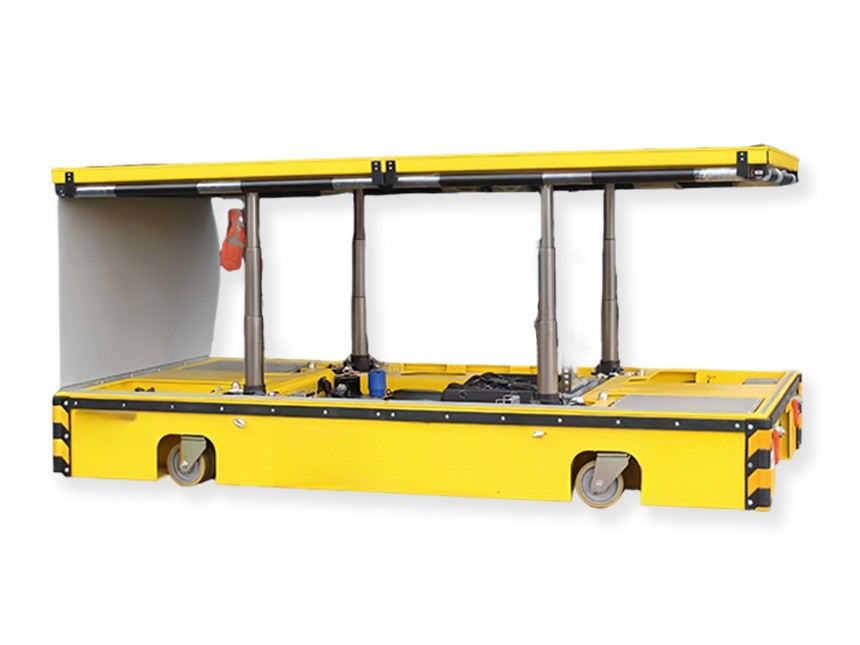
Introduction: Choosing the Right AGV Cart for Your Facility
When selecting an automated guided vehicle (AGV) cart for material handling, buyers often face a critical decision: should they invest in a rail transfer cart (rail-guided) or opt for a rail-less cart (autonomous navigation)? This choice fundamentally impacts your facility's layout flexibility, upfront investment, and long-term operational efficiency. Understanding the core differences between these two technologies is essential for making a cost-effective decision aligned with your production requirements.
1. Navigation Technology: How Each Cart Moves
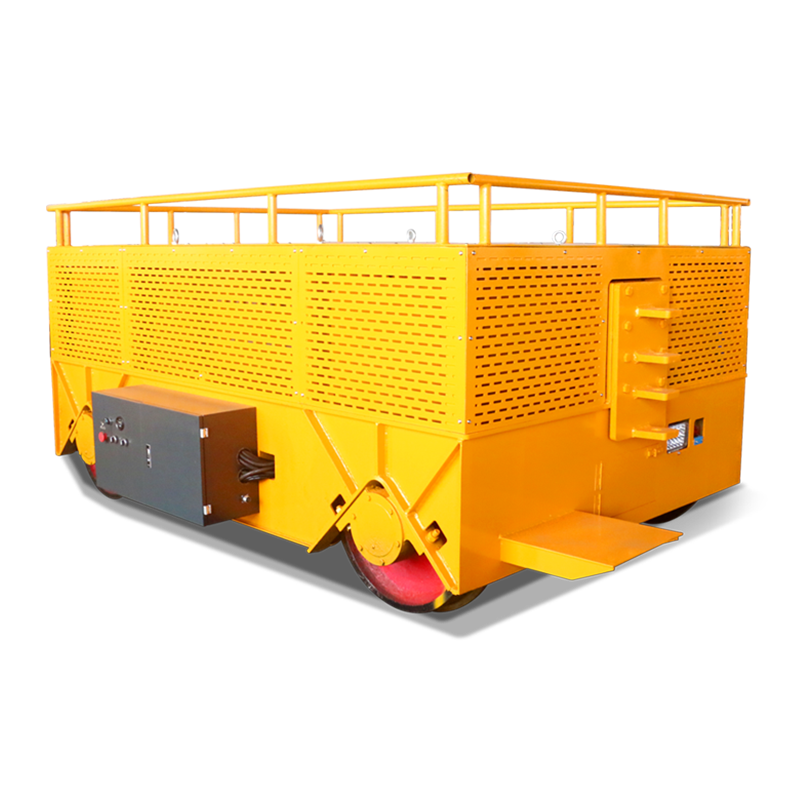
Rail Transfer Cart
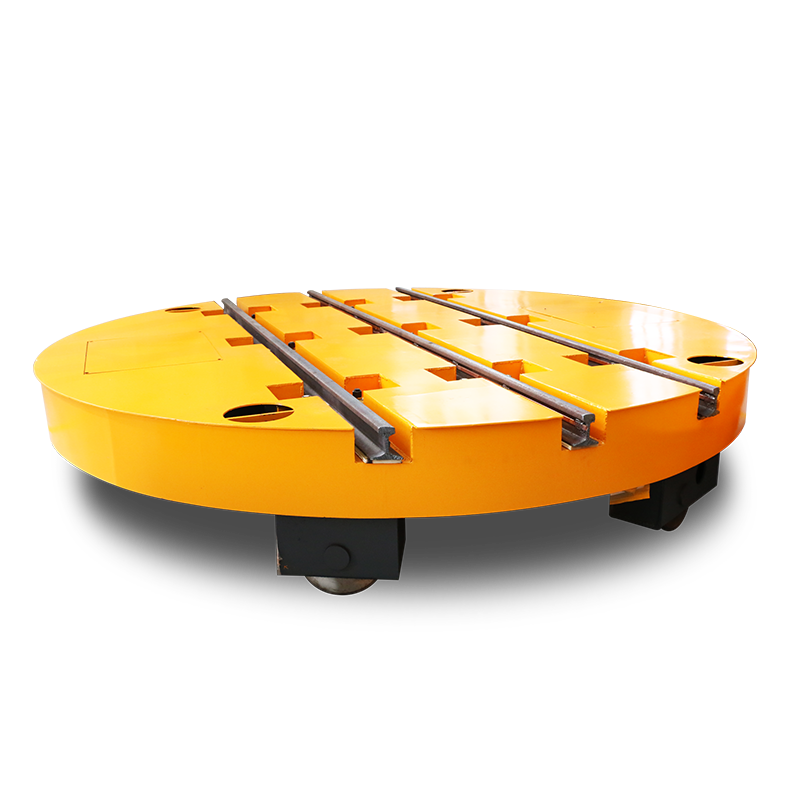
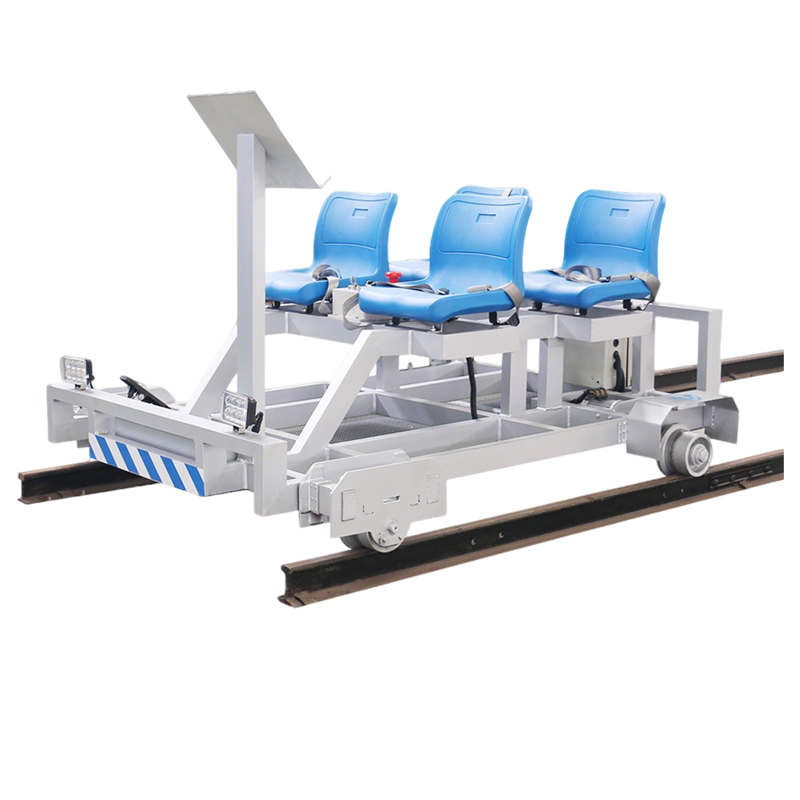
A rail transfer cart operates along predefined fixed rails or tracks installed on or below the floor surface. The cart's movement is physically constrained by these rails, ensuring high positional accuracy — typically within ±5mm. This system relies on buried wires, magnetic strips, or optical sensors embedded in the track infrastructure. Because the path is fixed and predictable, rail-guided carts deliver exceptional repeatability for high-volume, fixed-route applications such as assembly line feeding and heavy-duty stamping press transfers.
Rail-less Cart (Autonomous Navigation)
A rail-less cart uses laser scanning, vision systems, SLAM (Simultaneous Localization and Mapping), or vision-and-Lidar fusion to navigate freely within the facility. It dynamically plans its route in real time, avoiding obstacles and adapting to environmental changes. This approach eliminates the need for physical track infrastructure, offering significantly greater flexibility in environments where layouts change frequently or where multiple paths need to be traversed.
2. Installation Cost and Infrastructure
Rail transfer carts require substantial upfront infrastructure investment. Installing embedded wires, magnetic strips, or sensor tracks involves floor work, wiring, and commissioning — costs that can easily reach $50,000–$150,000 depending on facility size and track complexity. Once installed, modifying the route is expensive and disruptive.
Rail-less carts have a higher unit cost but minimal infrastructure requirements. A typical rail-less AGV may cost 20–40% more per unit than a rail-guided equivalent, yet with zero track installation cost, the total cost of ownership (TCO) for small-to-medium operations often favors rail-less solutions. For facilities with evolving layouts, the savings on future reconfiguration alone can be substantial.
3. Flexibility and Route Changeability
This is where the two technologies diverge most sharply. Rail transfer carts are inherently inflexible — the cart follows one path, and changing that path requires physical track modification. This makes rail-guided systems ideal for stable, high-throughput production lines with unchanging material flow patterns.
Rail-less carts reprogram in hours rather than weeks. Changing a route involves updating software parameters and re-mapping the environment — no floor work required. For warehouses, flexible manufacturing cells, and facilities undergoing frequent layout changes, rail-less autonomy is a strategic advantage that reduces reconfiguration costs and downtime.
4. Load Capacity and Application Suitability
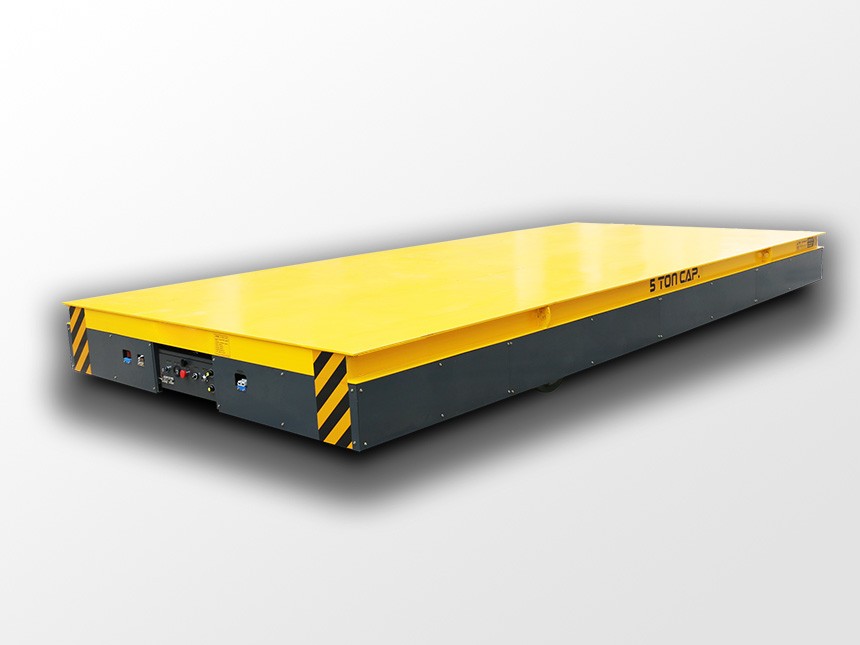
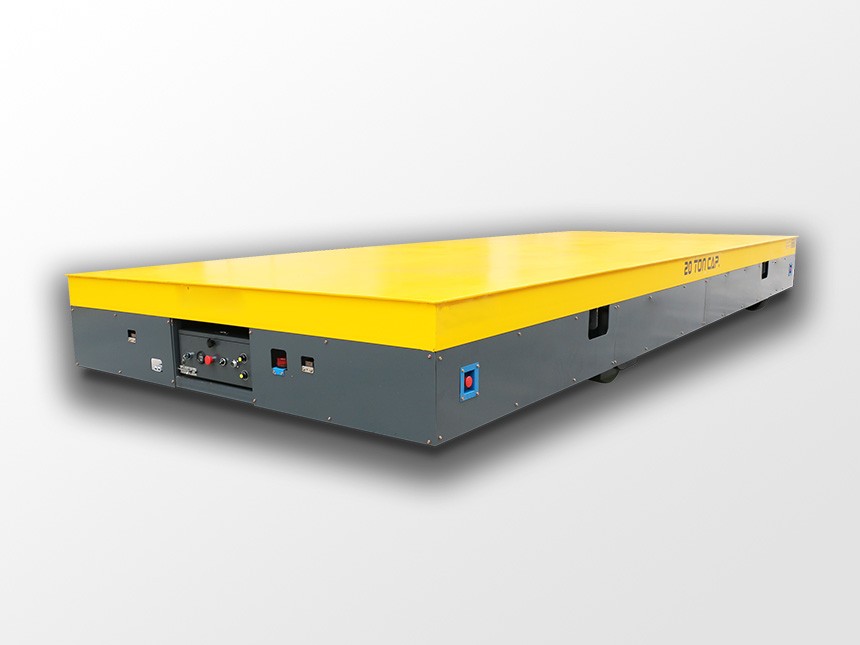
Rail transfer carts excel in heavy-load applications. Standard rail-guided transfer carts handle loads from 1 ton to 200+ tons with proven reliability. Their rigid track constraint means they can safely transport extremely heavy workpieces, hot-stamping parts, and large assemblies without deviation. Common capacities: 5t, 20t, 50t, 100t+.
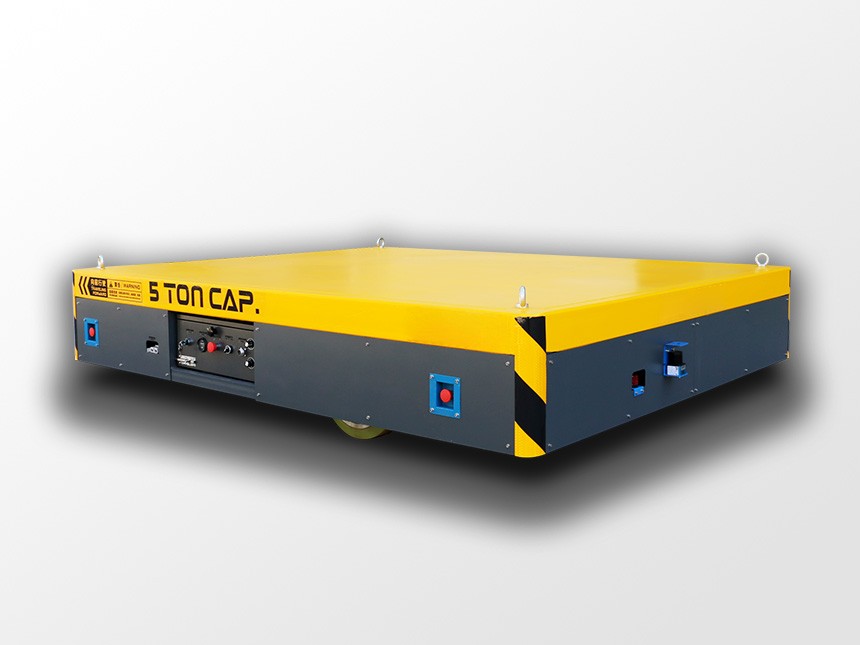
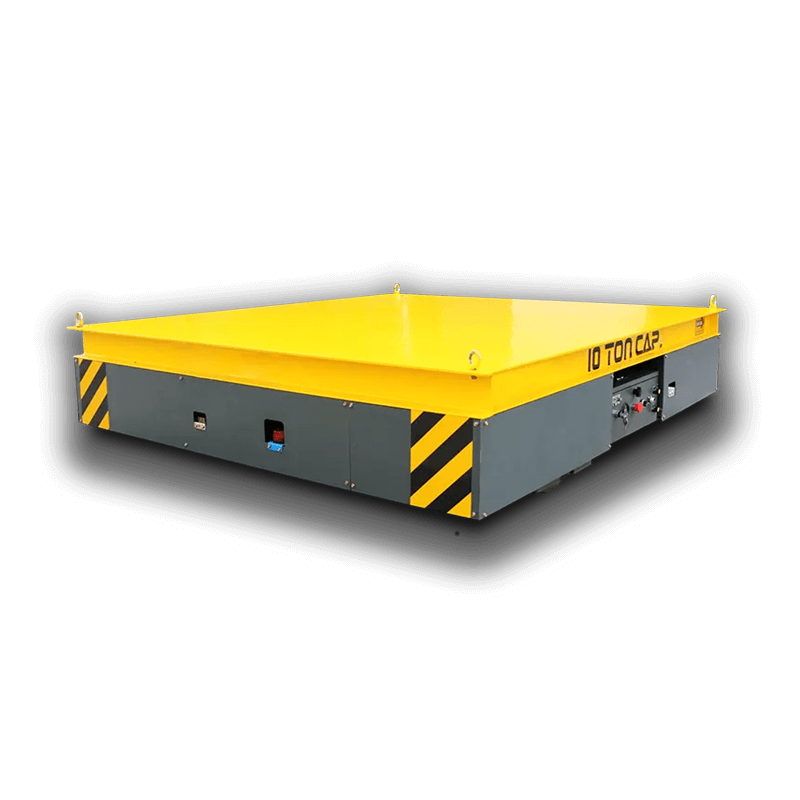
Rail-less carts typically serve loads up to 3 tons in most commercial configurations, with some heavy-duty models reaching 5–10 tons. While capabilities are expanding rapidly with advances in battery technology and motor power, rail-less systems are currently best suited for light-to-medium load applications where flexibility matters more than maximum capacity.
5. Safety and Reliability
Rail transfer carts operate in controlled, predictable environments. Since movement is constrained to known tracks, safety risk assessment is straightforward, and protective measures are well-established. Uptime is typically very high due to the simplicity of the guidance mechanism.
Rail-less carts carry more complex safety considerations — dynamic obstacle avoidance, sensor reliability, software fault tolerance — but modern AGV manufacturers have addressed these comprehensively. Leading rail-less AGVs comply with ISO 3691-4 safety standards, incorporate dual-channel safety circuits, and feature redundant sensor systems. In well-designed installations, rail-less carts can achieve availability rates above 99%.
6. Total Cost of Ownership (TCO) Comparison
Evaluating TCO requires a 5–10 year horizon. A simplified comparison:
- Rail Transfer Cart: Lower unit price + high infrastructure cost + moderate maintenance. Best economics for fixed, high-volume routes with loads exceeding 5 tons.
- Rail-less Cart: Higher unit price + near-zero infrastructure cost + software-based maintenance. Best economics for dynamic environments, evolving layouts, and loads under 3 tons.
For a facility planning 3+ major layout changes over a decade, rail-less carts typically save 30–50% on infrastructure and reconfiguration costs compared to rail-guided systems.
Decision Framework: Which Cart Should You Choose?
Choose a Rail Transfer Cart if:
- Your production layout is permanent and unlikely to change
- You need to transport loads exceeding 5 tons
- You operate in a structured environment with fixed, high-volume routes
- Maximum positional accuracy (within ±5mm) is critical
Choose a Rail-less Cart if:
- Your facility layout may change or expand in the future
- You need to serve multiple pickup and drop-off points across dynamic routes
- Loads are typically under 3 tons
- You want to avoid expensive floor work and track installation
- Fast commissioning and easy route reprogramming are priorities
Conclusion
Neither rail transfer carts nor rail-less carts are universally superior — the right choice depends entirely on your facility's specific operational profile. For heavy-load, fixed-route applications, rail-guided transfer carts deliver proven reliability and precision. For flexible, adaptive material handling in dynamic environments, rail-less autonomous carts offer superior long-term value. Conduct a thorough analysis of your load requirements, route stability, and anticipated layout changes before committing to either technology.
If you need assistance evaluating AGV cart options for your specific application, our engineering team provides free technical consultation and can recommend a solution tailored to your facility's requirements.